Tech Ideas That Made the Web Move Quicker Complete Info
The internet feels fast today, but it was not always this smooth. Years ago, tech ideas that made the web move quicker .Websites loaded slowly, videos buffered for minutes, and downloads took forever. Over time, developers and tech companies created smart solutions that changed how the web works. These innovations improved speed, reduced waiting time, and made online browsing easier for everyone.
Need To Know: Aajkitajikhabar.com Business Guide Growth & Online Media Trends
In this article, you will learn about the most important tech ideas made the web move quicker and how these ideas continue to improve modern internet performance.
What is Tech Ideas That Made the Web Move Quicker
Web speed affects almost everything online. People want websites to open instantly. Businesses also depend on fast-loading pages because users leave slow websites quickly.
Fast websites help with:
| Benefit | Why It Matters |
|---|---|
| Better user experience | Visitors stay longer |
| Improved SEO rankings | Search engines prefer fast sites |
| Higher sales | Faster stores get more buyers |
| Lower bounce rate | Users do not leave quickly |
| Better mobile browsing | Important for smartphone users |
Because of these reasons, developers always search for new tech ideas that made the web move quicker.
The Rise of Broadband Internet
One of the biggest changes in internet history was broadband technology. Older dial-up connections worked very slowly and blocked phone lines during use.
Broadband changed everything by offering:
- Faster download speeds
- Always-on internet access
- Better streaming quality
- Faster website loading
Cable internet and fiber networks later improved speed even more. Today, fiber internet can deliver extremely fast connections for homes and businesses.
Without broadband, modern websites and apps would not work smoothly.
Content Delivery Networks (CDNs)
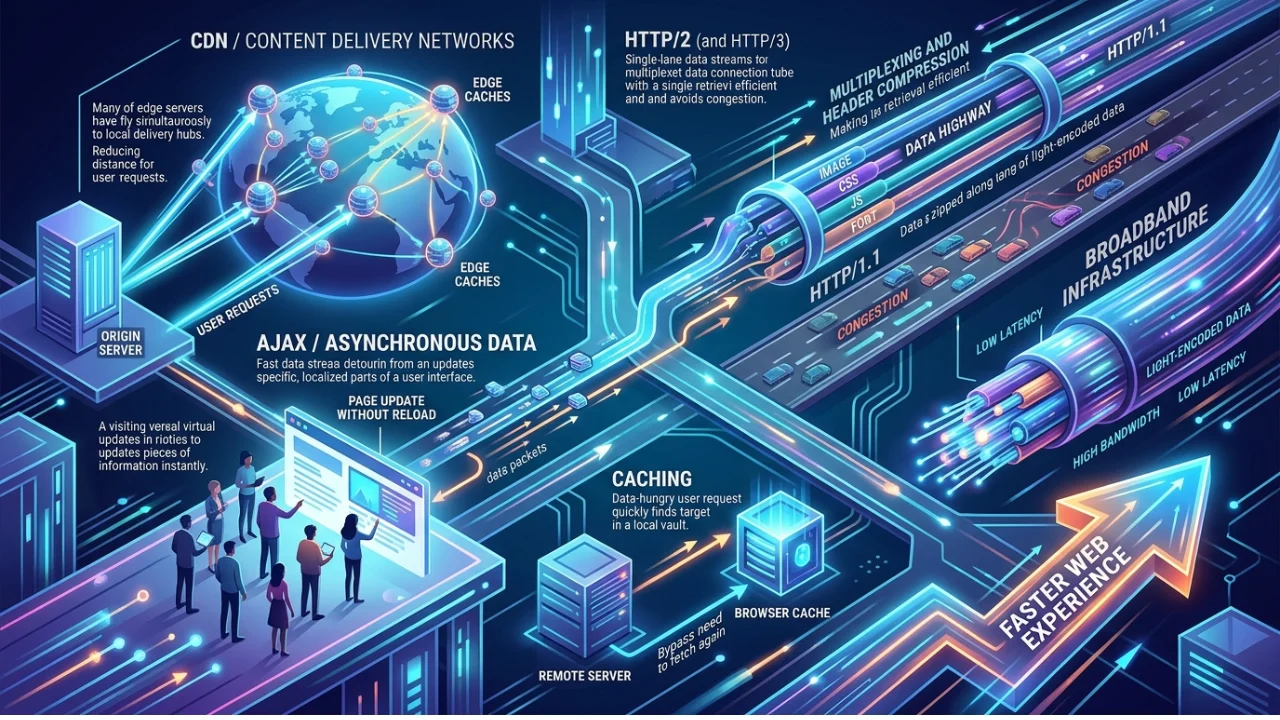
A Content Delivery Network, also called a CDN, became one of the smartest tech ideas that made the web move quicker.
A CDN stores copies of website files on servers around the world. When someone opens a website, the CDN sends files from the nearest server instead of one far away.
This reduces loading time and improves performance.
How CDNs Improve Speed
| CDN Feature | Speed Advantage |
|---|---|
| Local servers | Shorter data travel distance |
| Cached files | Faster content delivery |
| Load balancing | Prevents server overload |
| Image optimization | Faster image loading |
Popular websites use CDNs because they help millions of users access content quickly.
Browser Caching Technology
Browser caching is another major reason the internet feels faster today.
When you visit a website, your browser stores some files like images, styles, and scripts. The next time you open the same website, your browser loads these saved files instead of downloading them again.
This process saves time and reduces internet usage.
Caching became one of the most practical tech ideas that made the web move quicker because users visit the same websites repeatedly.
Faster Web Browsers
Modern browsers work much faster than older versions. Early browsers struggled with heavy websites and multimedia content.
Today’s browsers use powerful engines that process code quickly.
Modern Browser Improvements
- Better JavaScript performance
- Smarter memory management
- Faster rendering engines
- Improved security systems
- Background loading features
Browsers now load pages faster while using fewer system resources.
Image Compression and Optimization
Images are often the largest part of a webpage. Large image files slow down loading speed.
Developers solved this problem using image compression tools and modern formats.
Popular Image Optimization Methods
| Method | Result |
|---|---|
| Compression | Smaller file size |
| Lazy loading | Images load only when needed |
| WebP format | Better quality with smaller size |
| Responsive images | Correct image size for devices |
The Introduction of HTML5
HTML5 improved the web by reducing the need for heavy plugins and external software.
Older websites used Flash players for videos and animations. These tools slowed down browsers and caused crashes.
HTML5 allowed websites to play videos, audio, and animations directly inside the browser.
Benefits of HTML5
- Faster multimedia loading
- Better mobile support
- Lower resource usage
- Improved browser compatibility
This upgrade made websites cleaner, lighter, and faster.
Cloud Computing and Web Hosting
Traditional hosting systems had many limitations. Servers could crash when traffic increased suddenly.
Cloud computing solved this issue by spreading workloads across multiple servers.
This became one of the strongest tech ideas that made the web move quicker because websites could now handle millions of visitors without slowing down.
Cloud Hosting Advantages
| Feature | Impact |
|---|---|
| Scalable resources | Handles traffic spikes |
| Global server networks | Faster access worldwide |
| Better uptime | Fewer outages |
| Automatic optimization | Improved performance |
Cloud systems also support faster app performance and online storage.
Mobile Optimization
Smartphones changed internet usage forever. Websites designed only for desktops worked poorly on mobile devices.
Developers created responsive web design and mobile optimization methods to improve mobile browsing speed.
Mobile Speed Techniques
- Lightweight page design
- Mobile-friendly layouts
- Reduced file sizes
- Faster mobile caching
- Accelerated mobile pages
These improvements became important tech ideas that made the web move quicker for billions of mobile users.
HTTP/2 and Modern Web Protocols
Web protocols control how data moves between servers and browsers. Older protocols transferred data slowly.
HTTP/2 introduced smarter ways to send information online.
Key HTTP/2 Features
| Feature | Speed Benefit |
|---|---|
| Multiplexing | Multiple files load together |
| Header compression | Smaller data transfer |
| Server push | Faster resource delivery |
| Reduced latency | Quicker page response |
Modern protocols greatly improved website performance and reduced delays.
JavaScript Frameworks and Smarter Coding
Web developers now use advanced frameworks to create faster applications.
Older websites reloaded entire pages whenever users clicked something. Modern frameworks update only the necessary parts.
Popular Modern Approaches
- Single-page applications
- Component-based design
- Code splitting
- Lazy loading scripts
- Efficient rendering
These methods reduce unnecessary loading and improve user experience.
Fiber Optics and Faster Infrastructure
Internet speed also depends on physical infrastructure. Copper wires had speed limitations.
Fiber optic technology changed internet performance by sending data using light signals.
Benefits of Fiber Networks
| Feature | Advantage |
|---|---|
| High bandwidth | Faster speeds |
| Low latency | Quick response times |
| Stable connection | Better reliability |
| Long-distance performance | Stronger internet quality |
Fiber internet supports streaming, gaming, cloud computing, and remote work.
Artificial Intelligence for Speed Optimization
Artificial intelligence now helps websites run faster automatically.
AI tools analyze user behavior and optimize loading patterns. Some systems predict what users may click next and preload content early.
AI also improves:
- Smart caching
- Image compression
- Traffic management
- Security filtering
- Server optimization
The Role of 5G Technology
5G networks continue to improve mobile internet speed worldwide.
Compared to older mobile networks, 5G offers:
| Technology | Improvement |
|---|---|
| Faster downloads | Quick streaming |
| Lower latency | Better gaming |
| Stronger connectivity | Stable browsing |
| Higher capacity | Supports more devices |
5G helps websites and apps work smoothly on mobile devices.
How Developers Keep Improving Web Speed
The internet keeps evolving every year. Developers continue testing new methods to make websites even faster.
Current trends include:
- Edge computing
- AI-based optimization
- Progressive web apps
- Faster databases
- Lightweight coding systems
These innovations show that the search for better performance never stops.
Need To Know: Storypv Guide Benefits Safety & Anonymous Story Viewing
Conclusion
The internet became faster because of many smart innovations working together. Broadband internet, cloud computing, CDNs, browser caching, fiber optics, and AI all played major roles in improving web performance.
These tech ideas that made the web move quicker transformed how people browse, stream, shop, learn, and communicate online. Modern users now expect instant loading speeds, and developers continue building better solutions to meet those expectations.